

Gerald M. Brookhart
The Growing Impact of Small Things
Written by Amy Walters | Photos by David Vernon

Gerald M. Brookhart never left school. In fact, his earliest memory was of trying to follow his older brother to Kindergarten. “Back then we only lived about a block away from school," recalls Brookhart. "And so he went to school and I remember very clearly saying, ‘Oh, well, I think I want to go to school too.’” Brookhart hopped on his bicycle and pedaled over. But when he arrived, the Catholic school nuns sent him back home to impatiently wait one more year.
Brookhart grew up as one of four boys in a Catholic family in Davenport, Iowa. “My mom and my dad gave me so many great opportunities that most kids don't have. So I was certainly blessed with great parents and I've been able to have a great life.” He attended Saint Ambrose Academy for high school followed by Saint Ambrose College. “And then I was very fortunate and got a fellowship to go to Northwestern. And that was just the greatest place in the world. And then later on, I got a fellowship to go to Harvard, and that was something else. And I thought to myself, ‘If my mother could see me now! Daddy Buck and my mom would just be absolutely amazed.’”
Brookhart’s primary career objective was coaching. But in order to make a living as a coach, he also had to become a teacher. “So that's the way you could do it in Illinois, basically, the coaches are all teachers first and then coaches second.”
He taught and coached for one year at Aquin High School in Freeport, Illinois before two priests from Spalding came to recruit him. He jumped at the chance. “Not that I didn't like Freeport, but Spalding in Peoria was a much bigger opportunity.”
“Obviously, you can't change everything, but I did my best to turn out a lot of good men and a lot of good women along the way.”
Brookhart recalls his intense rivalry with Harry Whitaker. “When I was coaching at Spalding, he was a coach at Central and then he went on and became superintendent of District 150. And he and I were always, on the human level, friends. But on the basketball court, bitter enemies. I had to beat old Harry because he was always beating me. So we had some great battles there!”
Although Brookhart only spent five years at Spalding, they were very formative. “It's sometimes the smallest things that can lead to such great things.” Once, when Brookhart had cafeteria duty—one of his least favorite assignments—he saw a napkin on the floor and asked a nearby student to pick it up. “He picks it up and gave it to me and I put it in the trash. And I said, ‘You're a good man.’” When lunch was over, the same student approached Brookhart and said, “‘You know, Mr. Brookhart, nobody's ever called me a good man before.’ And I said, ‘Really?’ ‘No. And thank you so much.’”
That moment stuck with Brookhart. “Here's a kid who's in high school and nobody ever told him he was a good person before. Well, we wanted to change that. Obviously, you can't change everything, but I did my best to turn out a lot of good men and a lot of good women along the way.”
While teaching, Brookhart looked for opportunities to expand his own learning. “When I was teaching at Spalding, they didn't pay much, but they did give you full tuition to Bradley for graduate school. So right away, I took advantage of that.”
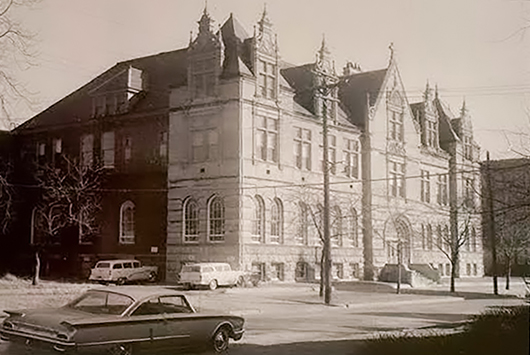
After earning his master’s degree from Bradley, Brookhart was serving as the principal of Gardner School, a small grade school in Peoria Heights, when a position opened in the Regional Office of Education (ROE). Brookhart ran for the elected office and won, serving as the Regional Superintendent of Schools for Peoria County and overseeing school operations across multiple counties in Central Illinois for 30 years.
Mary Jo Papich met Brookhart in 1986 while working in music education at Peoria Public Schools. She specifically remembers, “He cared passionately about the arts. He knew the value of the arts. He saw that as a teacher and as an administrator. And he was so supportive of all of us teachers in the arts; visual art and music.”
For Brookhart, one of his proudest achievements was launching early childhood education programs. “The city had received grant money and they hired me to be the administrator for their early childhood program, the first year of existence.” Then Brookhart helped launch a similar program in the valley working with local churches. “And it taught me an awful lot about life because when I got down in the Valley, I learned more in a year than I did the four years of college about real life.”
During that time, Brookhart discovered that less than one-third of the people in Illinois had kids in school. “That means only 27% of the families have things stuck on their refrigerators,” he says, envisioning a fridge covered in kids’ artwork and school projects. Brookhart believed that more people should be exposed to what kids were learning and making.
Then one day, while working for the ROE at the courthouse, Brookhart saw Phil Huber, the band director at Manual High School, holding a band concert in the courtyard. “There were literally hundreds and hundreds of people that came down to listen to the concert in the courthouse plaza." Brookhart realized this might be the opportunity he was looking for.
“So I called down to Mr. Huber and said, ‘Would it be okay if we came down to the courthouse and put up an art show by our little kids in the schools that are here for summer?’" Huber thought it was a great idea and Brookhart jumped into action.
They started with painted refrigerator boxes folded into triangles to display the kids’ artwork. “That night, Phil Huber's playing music and everybody was like, ‘Man, this is really something!’”
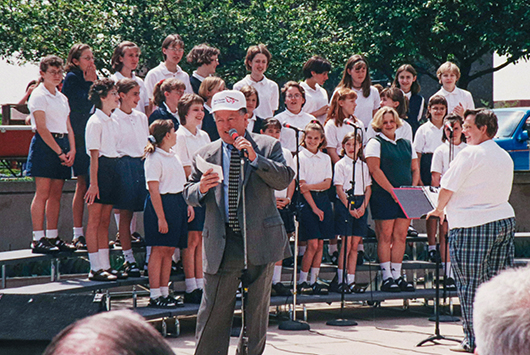
From there, the celebration expanded to displaying car engines and clothing and coin collections—anything students were working on. Music groups from across Central Illinois would come to play at three different downtown venues. Brookhart also saw this as an opportunity to connect kids from different schools. “So we had county kids and city kids always coming in at the same time.”
“He also started this, if I remember correctly, about the time the arts were starting to be cut from schools,” says Papich. “And he was ahead of his time thinking, ‘Hey, if you show your value and you're in the community performing, you'll be missed when you're gone.’ And I think that was a really great move.”
“And so it just kind of took off from there,” marvels Brookhart. “And it became kind of a fixture in the city; a kind of harbinger of spring.”
The Gerald M. Brookhart Arts in Education Spring Celebration is now in its 40th year. In 2026, 12,000 students from 136 schools in seven counties participated in performances, exhibits and demonstrations.
“I think Gerry probably never imagined that it would go for all these years—40 years—and he probably didn't realize the phenomenal effect, the reach of 400,000 students,” says Papich. “We're so grateful he came up with the idea, that he started it, that he put it into play, and we all have benefited from it.”
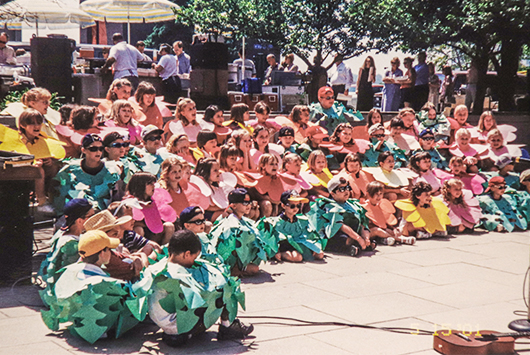
While Brookhart may not have imagined the impact of the arts celebration, the opportunity to influence lives has always been a driving force. “That everyday contact with young minds gives you the opportunity to make so much change and to make so much difference in people's lives—especially those who have had a very limited opportunity—that you can take those young people and they can go on and make great strides and do just outstanding things.”
As a long-time music educator, Papich can attest to the transformative power of participating in the arts. “The arts make a difference in one's life. And the students, by getting up and performing, whether they be very new at it as elementary students or seasoned like high school or college students, they learn transferable life skills. They learn confidence. They're motivated to work with others. So they learn collaboration, cooperation, they learn dependability.”
The accolades and appreciation do not come often for educators like Brookhart. But when they do, they stick with you. Brookhart remembers a time when he attended a concert at Cyd’s and afterwards joined the line of cars waiting to exit onto Knoxville. “And all of a sudden, a car about three cars up stopped. This young woman jumped out and she ran up to me in my car and said, ‘Oh, Mr. Brookhart, I am so happy to see you! You've done so much to change my life. I just wanted to thank you.’” Other cars were honking their horns for the line to move, but this young woman didn’t care. And Brookhart thought, “My God, you know, I must have done something right. And that, to me, was just a classic example of what a teacher can be.”