

Kert Huber
Building on a Strong Foundation
Written by Amy Walters | Photos by David Vernon
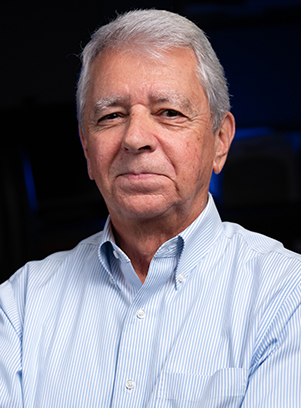
“Any building can be saved if there's a use for it,” says Kert Huber, with the caveat: “It has to have a reasonable foundation. Beyond that, all it takes is a use to make it economically feasible to do.” With over 40 years in commercial real estate development and redevelopment, Huber has the experience to prove it.
His own life was built on a solid foundation of honest, hard work. “We had a farm just outside of Galva. A perfect time and place to be, it really was. Farm life, family life; two older brothers, younger sister and mom and dad that I never once heard disagree with each other. So it was really a perfect way to grow up.”
Huber’s dad, the “quintessential farmer,” made sure that things were done right. His emphasis on integrity and fairness made a big impact on Huber, as did his older brother. “Dad said, ‘You’ve got to work.’ My brother said, ‘This is how you work.’ He taught me everything from riding a bike to buying my first car to giving me pointers on my first date.”
Another important influence came early in Huber’s career. “When I got a little older (21), I was working for a guy in Springfield, Illinois, by the name of Tom Whittle. Tom introduced me to a positive mental attitude. I’d always had it, but he showed me how to use it as a tool. And it stuck with me all through my life.”

After some time in Springfield, Huber started looking for a new direction. “I got a position that brought me from Springfield to Peoria, with Dawson Home Centers and I managed their contractor division, which gave me an interest in it. And then I went out and started doing construction work myself. Enjoyed it. I started building decks and installing fireplaces. I would sell the fireplace jobs in the evening and then install them during the day. And that led into larger construction projects. And from that we started developing property.”
One of Huber’s first major redevelopment challenges was the Judge Jacob Gale House. At the time, he had reconnected with Doreen, his high-school sweetheart, after a 20-year absence. “The first building that she was aware of that I had bought was the Jacob Gale House, and one side of it had fallen out. So, she was a little concerned about what she was getting into, just marrying this guy, you know? But it's worked out well. We're very happy.” Both their marriage, and the Gale House, are still standing 42 years later.
“So, that's the way I entered into development,” says Huber. “And then as buildings came available or as I saw them, I just had to get them looking better.”
While economic feasibility was crucial in considering building projects, Huber was also compelled by the ideas of continuity and transformation. “It’s fun to think about someone laying those bricks or those blocks in place 120 or 130 years ago, and we’re going to keep them there. I like that—it's a good feeling. We have several new buildings, and it's fine to do, but designing a new building is much more difficult for me than taking an existing building and finding a new purpose for it. That's where the fun is, the challenge is.”
Huber has completed hundreds of challenging buildings over the years, but if he had to choose a favorite, it would be 401 Water. “It was abandoned for 15 years. All the windows were boarded up. There's just raccoons and pigeons living there. It was the fall of ‘99 that we got possession of it and by Christmas of 2000, we occupied one of the condominiums.”

Huber’s daughter, Erikka Claerhout, had just started working for her dad around that time. She recalls showing the unfinished space to prospective tenants. “It took a lot of foresight out of people or them having to learn to trust us, as they're sitting here looking at dirty warehouse, that this could be their future home or their future office space and what really could be done with it.”
Now the 150,000 square foot building is more than just condos and offices; it’s a neighborhood. “I recall selling a place to a young woman from New York City,” says Huber. “And she walked through and after being in the building about 45 minutes, she says, ‘I'll take it!’ And I said, ‘Well, that's pretty quick. You sure you don’t want to think about it?’ She said, ‘No, the building has good karma.’ And it does. So that's one of the many reasons it's my favorite.”
The building has even served as inspiration for other major projects, such as the Commerce Bank Building, also known as 416 Main, which he tackled with his partner, Dave Golwitzer. “When I originally walked through that building, I was thinking, how can I take this building and say, wow, isn't this a cool building? And so we started putting glass in all the office doors to let light through. We started using lighter colors in it. And so when you sit there and decide what it is that it really needs and you start seeing it come to fruition, that's really a fun time in it.”
While it was tempting to just give the structure a facelift, they focused instead on building something that would last. “We could have modified the look of the building and saved a couple million dollars, but we didn't. We put it back. It was about $5 million just to make sure the top of that building was sound to last another 100 years. But I'm really glad we did it. And I think Dave is too.”

Integrity is important to Huber—both in his buildings and in his interactions. “I'd say fairness drives most of my decisions in dealing on contracts. And I find that most companies, if you work from a fair standpoint, most companies will work with you. You don't want to take advantage of someone. You don't want them to take advantage of you. And I'd say that's probably if you summed up what we do, it's fairness.”
Claerhout sees this fairness reflected in everything her dad does. “If he gives someone his word, you can count on it. He will follow through on that. And I think that's translated to a lot of long-term tenants that we've had. We've been able to keep them. They trust what Kert tells them and he always follows through with it.”
When asked what keeps him going in this business, Huber responds: “I guess I don’t know how to stop! My kids keep saying, ‘When you are you going to quit buying buildings?’ So, I have sold a few buildings in the last three or four years—probably sold more than I bought for the first time in my life, which is a little bit different. But I enjoy it.”
“I happen to hit a niche and figure out how to make a living from doing it in something that's fun for me.”
These days, he does some of his work while traveling with his wife to Florida and Missouri. “The nice thing about today's technology is I can make the decisions from anywhere. And I can see the projects from anywhere. And we have a great crew: my daughter is one of the crew and my son-in-law. So there's no reason for me to back out of it.”
Even with his travels, Huber is still very invested in Peoria. He has served on several construction and planning commissions as well as the Peoria RiverFront Association. He and his wife contribute to nonprofits that serve the homeless and he advocates for strategies that deal with underlying homelessness issues. “He's generous with a lot of organizations in this town and a lot of other things people maybe don't see,” says Claerhout. “He's always willing to work with someone and try to make life a little easier for them.”
Beyond that, Huber just loves Peoria. “Peorians need to understand that Peoria is a great town. We have a city skyline, which we should all be proud of. We have a lot of natural resources. We have all kinds of restaurants that are mom and pop owned. And we have a lot of nightlife here. My gosh, for a city our size, the cultural offerings that are offered in Peoria, you won't find in a city three times the size. But yet most people, they kind of knock it, ‘Well, I'm from Peoria,’ and they shouldn't. They need to embrace Peoria. It's a great town.”
So Huber's just going to keep doing the work he loves, in a place he loves, with the people he loves. “I happen to hit a niche and figure out how to make a living from doing it in something that's fun for me. Construction is fun, seeing things go up, and owning real estate. I think that comes from my farm boy background—being able to drive past a piece of property and say, ‘Yeah, that's my property.’ It really gives you a good feeling, kind of a little ego boost, no doubt about that, but also knowing that you've made that piece of property and it's going to be here after you're gone. It's pretty cool.”